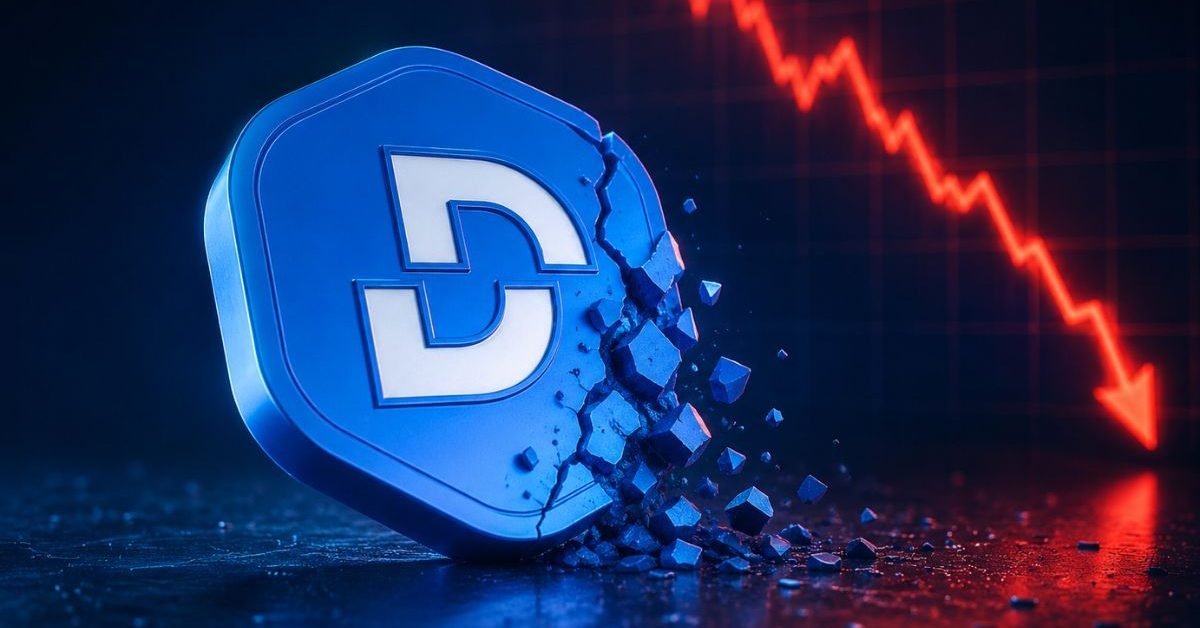
The cryptocurrency market is once again navigating turbulent waters, with Bitcoin’s recent multi-day slide creating significant headwinds across the digital asset landscape. However, it’s the pronounced decline in smart-contract and DeFi coins, highlighted by DeFi Coin Losses, that truly underscores the current market sentiment and exposes the vulnerabilities inherent in more speculative sectors of the ecosystem.
This downturn is more than just a typical correction; it’s a crucial indicator of shifting investor priorities, the ongoing battle with regulatory uncertainty, and the underlying technological strengths and weaknesses being tested. Understanding these dynamics is essential for anyone looking to make sense of the volatile crypto world.
The Current Market Retreat: Beyond Bitcoin’s Wobble
Bitcoin, the bellwether of the crypto market, has seen its price wilt for four consecutive days, pulling down the broader market capitalization with it. While Bitcoin’s resilience is often a point of pride, its sustained weakness signals a deeper, systemic apprehension among investors.
Crucially, the percentage losses among decentralized finance (DeFi) and smart-contract protocol tokens have significantly outpaced Bitcoin’s decline. This amplified volatility in altcoins suggests a risk-off environment where capital is fleeing assets perceived as higher risk.
Why Smart-Contract and DeFi Coins Losses Are Hit Harder
Decentralized finance protocols and the smart contracts that power them represent some of the most innovative applications of blockchain technology. These assets, however, often exhibit higher beta relative to Bitcoin, meaning they tend to amplify Bitcoin’s movements.
During market downturns, this characteristic means they suffer greater percentage drops. Factors contributing to their heightened sensitivity include lower liquidity, smaller market capitalizations, and often, more speculative investor bases.
Understanding Decentralized Finance (DeFi) Volatility
DeFi’s interconnected nature, built on composable smart contracts, can also magnify losses. A vulnerability or a liquidity crunch in one protocol can cascade across others, leading to rapid de-pegs or liquidations.
Many DeFi projects rely on leveraged positions, where users borrow against their crypto assets to maximize returns. When prices fall sharply, these positions can be automatically liquidated, further fueling downward pressure on prices. This creates a reflexive selling environment.
Investor Sentiment and Market Psychology
The current market behavior is heavily influenced by investor sentiment, often characterized by fear, uncertainty, and doubt (FUD). When Bitcoin shows sustained weakness, it triggers a flight to safety, with some investors converting digital assets into stablecoins or even traditional fiat currencies.
Retail investors, particularly those new to the crypto space, are often the most susceptible to panic selling during such periods. This contrasts with institutional investors who may view these dips as accumulation opportunities, albeit with caution regarding regulatory clarity.
Regulatory Headwinds and Their Influence
Regulatory uncertainty continues to cast a long shadow over the cryptocurrency market, especially for decentralized protocols. Jurisdictions globally are grappling with how to classify, oversee, and tax digital assets, particularly those that blur the lines between traditional finance and new technological paradigms.
Recent enforcement actions and increased scrutiny from bodies like the SEC contribute to market jitters, particularly for projects that might be deemed unregistered securities. This environment makes investors wary of assets without clear legal standing, as explored by Techtarget in its discussions on blockchain adoption challenges.
The lack of a unified global regulatory framework adds complexity, pushing some development and investment offshore. This fragmentation can hinder mainstream adoption and create uneven playing fields for innovation.
The Broader Crypto Ecosystem: Resilience and Innovation
Despite the current market downturn, it’s crucial to differentiate between short-term price action and the long-term trajectory of technological innovation. Developers continue to build and refine smart-contract platforms and DeFi protocols, focusing on scalability, security, and user experience.
Historically, bear markets have often been periods of significant technological advancement, as speculative noise subsides and genuine builders can focus. Projects with robust fundamentals, strong communities, and clear utility are more likely to weather these storms and emerge stronger.
The ongoing push for interoperability between different blockchains and the development of new financial primitives remains undeterred. Innovations in areas like zero-knowledge proofs and layer-2 scaling solutions continue to advance, promising more efficient and secure decentralized applications in the future. For instance, the broader fintech landscape is continuously evolving, with platforms like FV Bank’s unified fintech platform illustrating the convergence of traditional and digital finance.
What This Means for the Future of Decentralization
The current period of DeFi coin losses serves as a stress test for the entire decentralized ecosystem. It highlights the need for greater transparency, robust risk management, and perhaps, more user-friendly interfaces that simplify complex DeFi interactions.
These market cycles are a natural part of any nascent industry’s growth. They help flush out unsustainable projects and force a re-evaluation of value propositions. The long-term vision of a decentralized, permissionless financial system remains compelling, and these corrections contribute to its eventual maturation.
As Wired has explored, the broader Web3 vision, which includes DeFi, faces significant challenges but also holds immense potential for reshaping the digital landscape. Adaptability and continued innovation will be key to navigating these turbulent times.
Conclusion
The current market retreat, led by significant DeFi coin losses, is a stark reminder of the inherent volatility and risks within the cryptocurrency space. While painful for investors, these periods are integral to the market’s evolution.
They compel a focus on fundamental value, highlight the imperative of regulatory clarity, and ultimately foster a more resilient and mature ecosystem. For those committed to the long-term vision of decentralized finance, understanding these dynamics is crucial for navigating the path forward.
Frequently Asked Questions
Why are smart-contract and DeFi coins lossses more value than Bitcoin?
Smart-contract and DeFi coins often have lower liquidity and smaller market caps, making them more susceptible to larger percentage drops during market downturns. They are generally considered higher-risk assets and are the first to be sold off in a risk-off environment.
How does regulatory uncertainty impact DeFi markets?
Regulatory uncertainty creates apprehension among investors and developers, fearing potential crackdowns or unfavorable rulings. This can deter new capital, slow innovation, and lead to sell-offs in projects perceived to be at higher risk of regulatory action.
Is this market downturn a sign that DeFi is failing?
No, market downturns are a normal part of asset cycles, especially in nascent industries like crypto. While prices fall, development often continues, and these periods can cleanse the market of unsustainable projects, paving the way for stronger, more resilient innovations.