


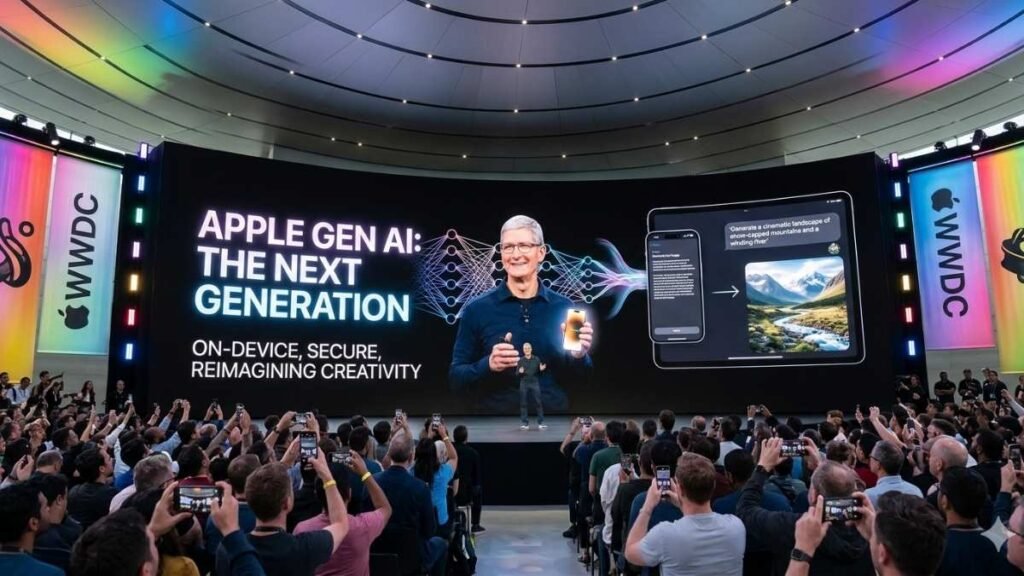
The usually tight-lipped Cupertino giant, Apple, appears to be laying the groundwork for a monumental shift in its approach to artificial intelligence. Reports indicate that the company is preparing to launch a new, dedicated ‘Gen AI’ website in the run-up to its annual Worldwide Developers Conference (WWDC). This isn’t just a minor update; it’s a strategic move signaling Apple’s unequivocal entry into the generative AI arena, potentially reshaping its entire product ecosystem and user experience. As tech journalists and industry analysts, we’ve long speculated about Apple’s ‘AI moment,’ and all signs point to WWDC 2024 being that pivotal event.
The ‘Gen AI’ Website: A Strategic Precursor
The creation of a standalone ‘Gen AI’ website is far more significant than a simple landing page for new features. It suggests a comprehensive, multi-faceted strategy designed to educate, engage, and perhaps even recruit. For a company known for its ‘show, don’t tell’ philosophy, dedicating an entire domain or sub-domain to Generative AI underscores a profound commitment. This website could serve several critical functions:
- Developer Resource Hub: Offering APIs, SDKs, documentation, and tutorials for developers to integrate Apple’s Gen AI capabilities into their apps. This is crucial for building a robust ecosystem.
- Vision Statement: Articulating Apple’s unique philosophy on AI, likely emphasizing privacy, on-device processing, and seamless integration with hardware.
- Showcase of Capabilities: Demonstrating what Apple’s Gen AI can do across various applications—from enhanced photo editing and video generation to smarter Siri interactions and personalized content creation.
- Talent Acquisition: A dedicated portal could also be a subtle recruitment tool, signaling Apple’s aggressive push to attract top AI talent.
This pre-WWDC launch creates immense anticipation, allowing developers and the public to familiarize themselves with Apple’s AI lexicon and foundational concepts before the full unveil. It positions Gen AI as a core pillar of Apple’s future, not just an add-on.
WWDC 2024: The Epicenter of Apple’s AI Vision
WWDC has always been the stage for Apple’s software innovations, and this year, it’s expected to be dominated by AI. The ‘Gen AI’ website is merely the opening act for what promises to be a transformative conference. We anticipate major announcements centered around:
iOS 18 and macOS 15: AI at the Core
The next iterations of Apple’s flagship operating systems, iOS 18 and macOS 15, are poised to be fundamentally reimagined with generative AI. This could manifest in:
- Siri Overhaul: A long-awaited, genuinely intelligent Siri capable of natural language understanding, complex multi-turn conversations, and proactive assistance, leveraging a large language model (LLM).
- Generative Features: AI-powered summaries in Safari and Notes, automated email drafting, advanced photo and video editing capabilities (e.g., object removal, style transfer), and dynamic wallpaper generation.
- System-Wide Integration: Deeper AI integration across core apps like Messages, Mail, Pages, and Keynote, enabling smart replies, content creation, and data analysis.
- Accessibility Enhancements: AI-driven features that make Apple devices even more accessible through advanced voice control, predictive text, and personalized assistance.
On-Device vs. Cloud AI: Apple’s Differentiator
A key aspect of Apple’s AI strategy is expected to be its emphasis on on-device processing. Unlike many competitors that heavily rely on cloud-based AI, Apple’s powerful custom silicon (A-series, M-series chips with dedicated Neural Engines) allows for a significant portion of AI computations to occur directly on the device. This approach offers several distinct advantages:
- Enhanced Privacy: User data remains on the device, minimizing privacy concerns associated with sending sensitive information to external servers.
- Lower Latency: Faster response times for AI features as data doesn’t need to travel to and from the cloud.
- Offline Functionality: Many AI features could work even without an internet connection.
- Cost Efficiency: Reduces Apple’s own cloud infrastructure costs and potentially saves users data bandwidth.
This on-device focus could become a significant competitive advantage, especially in a world increasingly wary of data privacy. According to a report by Wired, Apple’s long-term commitment to silicon and privacy sets it apart in the AI race.
Apple’s AI Ambitions: Catching Up or Redefining?
For years, Apple has been criticized for lagging behind rivals like Google and Microsoft in the generative AI race. While Google has been aggressively integrating its Gemini AI into the Mac ecosystem, offering tools like Spark Agent and voice control, Apple has maintained a more cautious, deliberate pace. This new ‘Gen AI’ initiative suggests Apple isn’t merely playing catch-up but aims to redefine what AI means in a consumer context. Rather than focusing on a broad, general-purpose chatbot, Apple’s strategy will likely center on ‘practical AI’ that deeply enhances the user experience across its products.
The emphasis will probably be on integration and utility, making AI features feel less like a separate entity and more like an intuitive extension of the Apple ecosystem. This echoes Apple’s historical approach to new technologies, often waiting for the technology to mature before integrating it seamlessly and securely.
Beyond Siri: A New Era for Apple Intelligence
While Siri’s evolution will undoubtedly be a cornerstone, Apple’s Gen AI ambitions extend far beyond. Imagine an iOS that proactively suggests actions based on your context, a Photos app that can generate entire new sections of an image based on your prompt, or a Vision Pro experience where AI agents assist in mixed reality environments. The possibilities are vast, leveraging Apple’s unique position as a vertically integrated company controlling both hardware and software.
The company’s substantial investments in AI research and development, though often under the radar, have been building for years. Reports from sources like Bloomberg have consistently highlighted Apple’s internal ‘Ajax’ LLM project and its focus on efficiency and privacy. This foundation is now ready for public deployment.
Impact on the Ecosystem and User Experience
The implications of Apple’s Gen AI push are profound, touching every facet of its ecosystem:
- Developers: A new suite of AI tools and APIs will unlock unprecedented creative potential, allowing for innovative app development.
- Users: Expect a more intuitive, personalized, and efficient experience across all Apple devices, from iPhone and iPad to Mac, Apple Watch, and Vision Pro.
- Competitors: Apple’s entry will intensify the AI arms race, forcing rivals to further innovate, especially in areas like privacy and on-device capabilities.
- Industry Standards: Apple’s adherence to high standards for privacy and responsible AI could influence broader industry practices.
Challenges and Opportunities Ahead
While the opportunities are immense, Apple also faces significant challenges. Ensuring data privacy while delivering powerful AI is a delicate balance. The ethical implications of generative AI, combating misinformation, and maintaining high standards of accuracy will be crucial. Furthermore, managing consumer expectations, especially after years of relatively modest AI updates, will require careful communication.
However, Apple’s strengths—its brand loyalty, massive user base (over 2 billion active devices), integrated ecosystem, and control over its silicon—position it uniquely to navigate these challenges and potentially emerge as a dominant force in the generative AI landscape. The launch of the ‘Gen AI’ website is not just a leak; it’s a carefully orchestrated prelude to what could be the most important WWDC in years, marking Apple’s definitive embrace of the AI future.
Frequently Asked Questions
What is ‘Gen AI’ and why is Apple suddenly emphasizing it?
Generative AI refers to artificial intelligence models capable of generating new content, such as text, images, audio, and video, often based on prompts. Apple is emphasizing it now because the technology has matured to a point where it can be seamlessly integrated into its ecosystem to provide meaningful, private, and on-device user experiences, catching up with and differentiating from competitors.
How will Apple’s Gen AI differ from competitors like Google’s Gemini or OpenAI’s ChatGPT?
Apple’s Gen AI is expected to heavily prioritize on-device processing for privacy and performance, deeper integration across its hardware and software ecosystem, and a focus on practical, utility-driven features rather than purely conversational chatbots. It will likely leverage Apple’s custom silicon for superior efficiency and security.
What can users expect from iOS 18 and macOS 15 with these new AI features?
Users can anticipate a significantly smarter Siri, advanced generative capabilities in core apps (e.g., photo editing, text summarization, email drafting), more personalized experiences, and potentially new accessibility features. These changes aim to make devices more intuitive, proactive, and powerful while keeping user data private.